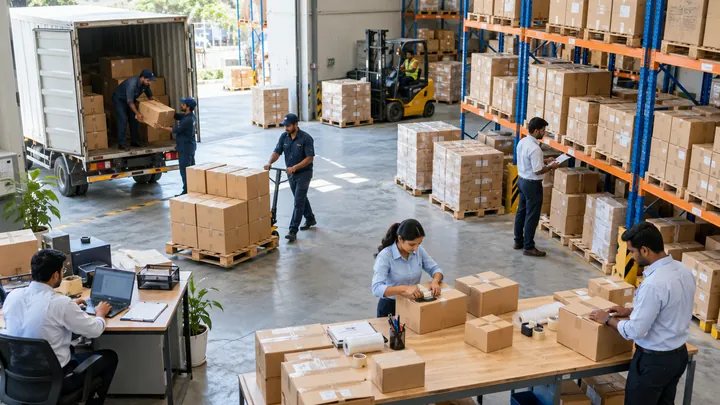
A test purchase examines invoicing conduct
Section 67(12) of the CGST Act permits the Commissioner or an officer authorised by him to cause an authorised person to purchase goods, services or both from a taxable person's business premises to check whether tax invoices or bills of supply are issued. On return of goods so purchased, the taxable person or person in charge must refund the amount paid towards those goods after cancelling any earlier tax invoice or bill of supply.
Read the applicable text: CBIC CGST Act: section 67(12), contrasted with section 154.
Keep the goods-return limb distinct
The purchasing power covers services too, but the express return-and-refund wording refers to goods returned. Do not invent an identical physical-return mechanism for a completed service. Establish the actual transaction, document and return facts before determining the required action.
Preserve the original transaction
Retain the original invoice or bill of supply, payment evidence, item description and quantity. A subsequently produced document does not prove that it was issued at the purchase. Preserve system timestamps and the original record rather than replacing evidence of the event under review.
Reconcile the return and money separately
Map the goods returned to their original document and amount paid, cancel the relevant issued document as required and preserve the cancellation trail. Record the refund and inventory movement separately so that a refund does not disappear merely because stock was restored. For partial returns or mixed goods/services facts, establish the supported attributable amount and the legally appropriate document treatment rather than cancelling unrelated supplies mechanically.
Do not confuse other GST procedures
Sampling under section 154 involves taking samples and providing a receipt; it is a different power. A test purchase is also not automatically a seizure, confiscation or ordinary customer credit-note exercise. Section 67(12) itself does not supply a universal refund form, a fixed refund processing period or a blanket exemption from applicable return-reporting rules.
Close an evidence-based response
Explain the purchase, document issue, goods return, cancellation and refund chronologically. Reconcile cash or bank outflow to the refunded amount. The illustrative tax splits below use an assumed 18% rate solely to show arithmetic; they do not classify any particular product.
Six worked illustrations
All facts and amounts are fictional. Calculations illustrate the stated assumptions, not a predetermined legal outcome.
Illustrative example 1: Full return of taxed goods
Assume goods priced ₹1,000 plus assumed GST of 18% were purchased for ₹1,180 and fully returned. The goods-related payment to reconcile is ₹1,180: ₹1,000 plus ₹180. Refunding only ₹1,000 leaves ₹180 of that payment unreconciled.
Illustrative example 2: Two items fully returned
Two goods items have assumed pre-tax prices ₹600 and ₹400 at the same assumed 18% rate. Total payment is ₹1,180. Returning both maps to ₹708 and ₹472 respectively, totalling ₹1,180; preserve the original invoice cancellation evidence.
Illustrative example 3: Payment split between modes
A goods purchase of ₹2,360 was paid ₹1,000 in cash and ₹1,360 by bank. Full return requires reconciliation of the full ₹2,360. Refund evidence for only the bank portion leaves ₹1,000 outstanding in the working.
Illustrative example 4: Partial return needs item identification
A purchase contains ten identical goods units at an assumed tax-inclusive ₹118 each, total ₹1,180. Four units returned correspond to ₹472 and six retained units to ₹708. This allocation supports investigation of partial-return treatment; it does not authorise erasing the retained supply or impose a universal cancellation method.
Illustrative example 5: Refund made in two instalments
A supported goods refund is ₹5,900. Payments of ₹4,000 and ₹1,900 clear it exactly. A claim that ₹4,000 alone completed the refund leaves ₹1,900 unexplained even if the goods ledger has been updated.
Illustrative example 6: Sampling and purchasing are different records
A file contains three test purchases and two departmental sample receipts. That is five events, but only three are purchase events. Do not create five purchase-refund liabilities merely by counting the entire departmental-event folder.
Ten-step verification table
| Step | Action | Evidence |
|---|---|---|
| 1 | Identify the power invoked | Authorisation and proceeding record. |
| 2 | Record the actual purchase | Time, premises and purchaser evidence. |
| 3 | Classify goods and services | Transaction-specific scope. |
| 4 | Preserve the issued document | Original invoice or bill of supply. |
| 5 | Match payments | Cash and bank evidence. |
| 6 | Verify returned goods | Item IDs, quantity and receipt. |
| 7 | Document cancellation treatment | Original-reference audit trail. |
| 8 | Reconcile the refund | Amount paid, refunded and remaining. |
| 9 | Reconcile inventory and reporting | Stock movement and applicable return review. |
| 10 | Close the response pack | Chronology and supported exceptions. |
Sixteen practitioner FAQs
1. What is the stated purpose of the purchase?
Checking issue of tax invoices or bills of supply.
2. Can services be purchased under this power?
Yes; the purchasing limb includes goods, services or both.
3. Does the physical goods-return rule automatically fit services?
No. Read the goods-specific refund wording.
4. Who may cause the purchase?
The Commissioner or an officer authorised by him, through an authorised person.
5. Where does the provision identify the purchase?
At the taxable person's business premises.
6. Who refunds the returned goods amount?
The taxable person or person in charge of the premises.
7. What happens to an earlier invoice or bill of supply?
The provision requires its cancellation in the stated goods-return case.
8. Is restoring stock enough?
No. Reconcile document and refund evidence too.
9. Can an invoice generated later prove timely issue?
Its timing and original transaction evidence still need examination.
10. Are sample receipts test-purchase invoices?
They concern a different statutory mechanism.
11. Is every test purchase a confiscation?
Do not conflate the separate powers and conditions.
12. Does the section prescribe one universal refund form?
Do not invent one from this subsection.
13. Can unrelated retained goods simply disappear from the records?
No. Resolve partial-return facts and appropriate treatment.
14. Do the example rates classify products?
No. The rate is an explicit arithmetic assumption.
15. Should cash refunds have evidence?
Retain a supported payment and acknowledgement trail.
16. What closes the working?
Purchase, document, return, cancellation and refund records reconcile.