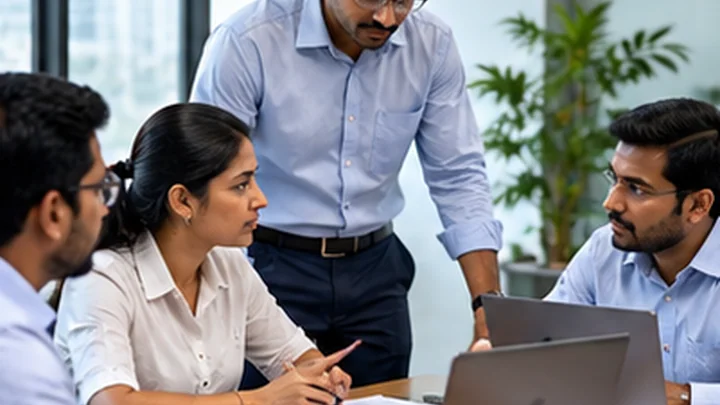
Every Hour Saved at Work Is an Hour a CA Student Can Invest in Their Future.
A Different Kind of Deadline
It is 8:45 PM. Most of the office has quietened down, but a CA articled assistant is still at a desk. An Excel workbook is open. A few audit schedules need to be updated. Numbers from the trial balance have to be copied into another format. A previous-year file needs to be checked, and the final presentation is still not ready.
There is also a lecture to revise, a chapter to complete and an examination to prepare for.
The student knows that tomorrow will bring another full working day. The question is not whether the office work matters. It does. The question is whether every hour spent completing it is adding equal value—to the client, the firm or the student's professional education.
Now imagine a different ending to the same day: routine figures have already flowed into the relevant schedules, obvious mismatches have been flagged, and the article spends the remaining time understanding the exceptions with a senior. The work is reviewed, the assignment moves forward and the student leaves at a reasonable hour.
That is the possibility worth discussing. Not less responsibility. Smarter work, better learning and time that can be used more meaningfully.
Articleship Is Professional Training, Not Just Task Completion
Articleship is an important bridge between studying Chartered Accountancy and practising it. It is where a student learns how records become financial statements; why an audit observation matters; how tax provisions apply to actual transactions; and how professional scepticism, documentation and client communication work in real engagements.
Routine tasks have a place in this training. An article may need to map a trial balance manually to understand classifications, prepare a reconciliation to appreciate the underlying controls, or trace a transaction to learn how audit evidence is evaluated. The first time such work is performed can be educational. Repeating the same mechanical steps for the twentieth time may not be.
A good articleship should gradually move students from performing a process to understanding, questioning and reviewing it. Technology can support that progression. It can take over more of the repetitive preparation while leaving students and their seniors responsible for the thinking.
Where Does the Working Day Actually Go?
Anyone who has worked through an audit or tax compliance season will recognise some of these activities:
- Re-entering client names, identification details and prior-year information into multiple forms or workbooks.
- Copying trial-balance figures into financial-statement formats and manually grouping similar ledgers.
- Preparing the same comparative columns, notes or supporting schedules again and again.
- Checking formula links, formatting tables and aligning numbers just before a report goes out.
- Maintaining separate Excel trackers for assignments, review points and statutory deadlines.
- Reworking schedules after a late adjustment because the same information exists in several files.
Some of this work requires understanding. Much of the repeated movement, formatting and checking of the same data does not.
This creates a hidden cost. It is not merely the time spent clicking and copying. It is the attention lost when students and seniors must repeatedly return to mechanical tasks instead of concentrating on the matters that need professional judgment.
And when a client shares information late or a deadline is close, even small inefficiencies can become an evening of additional work.
Late Sittings: Sometimes Necessary, But Should They Become the Default?
Professional services involve deadlines. Audits can reveal unexpected issues. Clients may provide incomplete records. Tax and regulatory work often follows fixed timelines. No responsible technology discussion should pretend that every late sitting can simply disappear.
Equally, it is reasonable to ask whether avoidable repetition is making already demanding seasons harder than they need to be.
A late evening spent resolving a material audit issue, discussing a complex tax position or finalising important reporting judgments is different from a late evening spent copying unchanged figures or fixing layouts across multiple spreadsheets.
The answer is not to blame students, seniors or firm partners. Many firms work under intense client and compliance pressures. The better response is to improve the processes around those pressures: earlier planning, clearer responsibility, timely client-data requests, better review practices and appropriate automation.
Technology is one part of that improvement—not an excuse to replace thoughtful workload management.
What Automation Can Actually Change in a CA Firm
Automation becomes useful when it addresses familiar, measurable tasks rather than promising to do everything through a single button.
| Common task | Smarter workflow | What still requires professional review |
|---|---|---|
| Preparing financial statements from a trial balance | Reuse imported balances, ledger groupings and prior-year presentation | Correct classification, adjustments, disclosures and final figures |
| Rolling forward recurring information | Carry forward appropriate master data and opening balances | Changes during the year and accuracy of the source |
| Preparing tax-audit workings | Reuse supported source data and structured schedules | Applicability, supporting evidence, exceptions and reporting decisions |
| Updating figures after adjustments | Make controlled changes in a connected working process | Reconciliation, approval and effect on related disclosures |
| Monitoring client assignments | Maintain a shared view of owners, status and pending information | Priorities, follow-up, escalation and client communication |
Consider financial-statement preparation. In a largely manual workflow, a student may receive the trial balance, identify each ledger, fill reporting schedules, update comparatives, format notes and then repeat parts of the exercise after adjustments. In a better-designed workflow, much of the routine mapping and presentation can be reused. The student can focus on unusual balances, classification questions, disclosures and whether the statements actually make sense.
The objective is not to skip the work that teaches accounting. It is to stop requiring every student to repeat clerical steps long after the underlying concepts are understood.
Nor is a percentage such as “90% time saved” a universal promise. Savings depend on the quality of client records, the complexity of the engagement, the maturity of the process and the review controls. The sensible approach is to measure time on a specific task before and after automation—and assess quality alongside speed.
What Could Two Hours Back Mean to a CA Student?
Imagine that a firm improves its workflow enough for an article to finish certain routine assignments two hours earlier on some days. This is an illustrative possibility, not a measured result or a guaranteed outcome.
For one student, that time might mean revising an accounting standard without fighting fatigue. For another, it might mean attending a lecture regularly, discussing a difficult concept with peers, spending time with family, exercising or simply getting enough rest.
Those activities are not distractions from professional development. They are part of making sustained professional learning possible.
The emotional value of a saved hour can be greater than its billing value. A student who reaches home with the energy to study may be better prepared for examinations. A student who has time to understand the why behind the day's work may return with better questions the next morning.
Every hour saved at work is an opportunity. What matters is that the student genuinely gets to use some of that opportunity. Saving time through software is not a success for articleship if the same hours are automatically filled with more low-value tasks.
The Benefit Is Just as Real for CA Firms
This is not a students-versus-firms conversation. In fact, firms have strong reasons to lead the change.
Well-designed processes can reduce avoidable rework and help teams deliver more consistently. Clearer data flow may make review easier. Partners and managers can spend less time identifying formatting mistakes and more time evaluating the issues that matter to clients. Students with better training and a healthier routine may be more engaged and better able to take responsibility as they progress.
A technology-enabled firm can also offer a stronger learning experience: articles can work on analytical reviews, financial-statement interpretation, risk assessment, tax research, documentation, controls and client discussions—not simply preparation of yet another spreadsheet.
These are advantages worth pursuing regardless of firm size. Small and mid-sized practices, in particular, need practical tools that fit their teams and budgets rather than adding another complicated system to manage.
A productive firm is not necessarily the one where the lights remain on longest. It is the one that combines sound judgment, effective systems and meaningful professional training.
Automation Should Strengthen Judgment, Not Replace It
There is an important distinction between a system that prepares a draft and a professional who accepts responsibility for it.
Software may map ledgers, carry forward information or flag differences. It cannot be treated as proof that a classification is correct, that sufficient audit evidence exists or that a tax position is appropriate. A well-designed workflow must allow an article to trace figures back to the source, understand changes, investigate exceptions and obtain the required review.
The ideal progression for a CA student is:
- Understand the task — learn the accounting, audit or tax principle involved.
- Use technology to prepare efficiently — avoid unnecessary re-entry and manual formatting.
- Investigate exceptions — ask what changed, what is missing and what needs judgment.
- Document the conclusion — preserve evidence and the reasoning behind adjustments.
- Learn from the reviewer — turn review comments into deeper technical understanding.
This is not a shortcut around articleship. It is a way to make articleship more valuable.
Five Practical Changes Firms Can Start With
A firm does not need a complete technological overhaul to improve working hours. It can begin with a few deliberate changes:
- Identify the most repetitive work. Ask articles and seniors which tasks repeatedly consume hours without adding much new learning.
- Standardise inputs and review formats. Consistent client-data requests, ledger classifications and working-paper structures reduce confusion before any software is introduced.
- Reuse information responsibly. Prior-year masters, approved groupings and available source information should be reused where appropriate, with current-year verification.
- Automate the repeatable, review the exceptional. Give technology routine preparation and calculation; give people interpretation, evidence, judgment and sign-off.
- Measure both efficiency and learning. Track preparation time, rework, review findings and whether students are receiving better exposure—not just the number of assignments completed.
Firm leadership also needs to protect the time gained. A process improvement creates a better articleship only when some of that capacity becomes space for learning, structured feedback and a more sustainable routine.
Where AssureOffice Fits Into This Vision
At assureOffice, we are building practical tools for accounting and tax professionals with a straightforward goal: less repetitive work and more professional insight.
The suite focuses on workflows such as financial-statement preparation, tax-audit data reuse and preparation, and practice and assignment management. For example, supported imports and reusable information in assureFinancials can reduce manual financial-report preparation steps; assureTax supports structured tax-audit preparation with available source information and prior-year continuity; and assurePractice focuses on organising professional assignments and team progress.
These tools are intended to assist—not replace—the people who review and take responsibility for professional work. Their usefulness depends on the engagement, source data and proper verification.
We believe technology should be accessible to firms that want to train stronger professionals, serve clients better and build more sustainable working practices.
Explore assureOffice: https://assureoffice.in/
A Thought Worth Taking Back to Every CA Office
Perhaps the next time an article stays late, we should ask a better question than “How many more hours will this take?”
“Which part of this work truly needs a person's expertise—and which part could a better process have completed earlier?”
Not every deadline will become easy. Not every evening will end on time. But if we can reduce avoidable clerical effort, improve professional learning and help firms deliver quality work more efficiently, that is meaningful progress.
For CA students, it may mean more time to study and grow. For CA firms, it may mean stronger teams, better review and more capacity for valuable client work.
And for the profession, it may mean an articleship experience that prepares future Chartered Accountants not only to work hard, but to think deeply and work intelligently.
To CA students and articled assistants: Which repetitive task takes up more time than it should during your articleship?
To CA firm partners and seniors: What change—technology, training or process—has made the biggest difference to your team's working hours?